
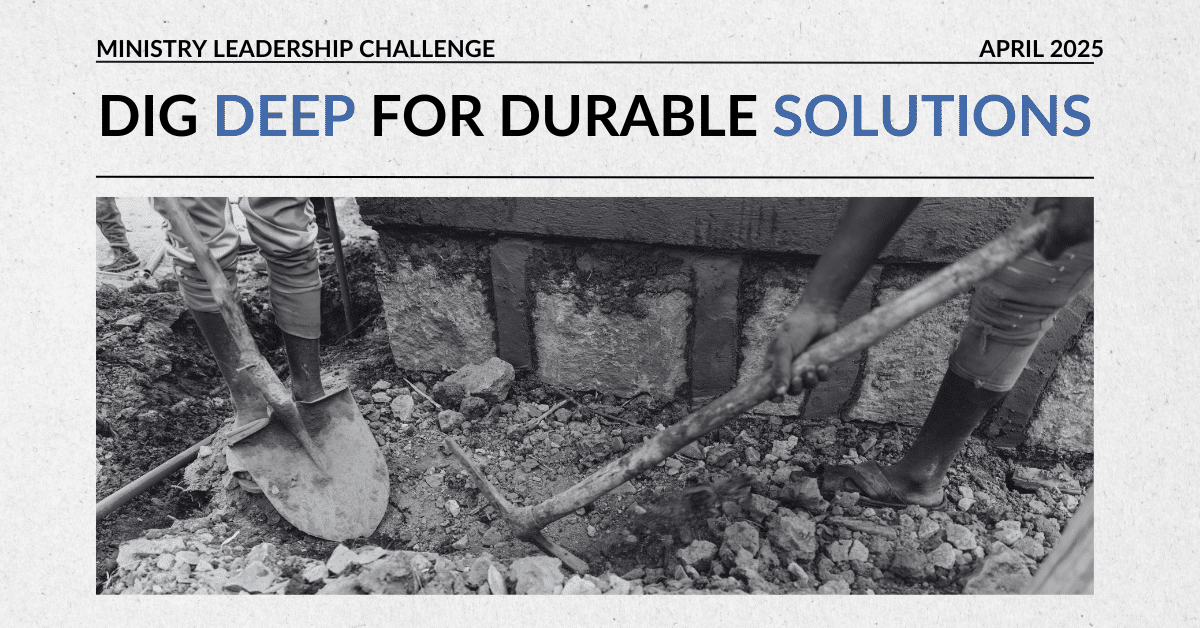
Ministry Leadership Challenge
April 2025
Ministry Leadership Challenge: Dig Deep for Durable Solutions
We all know the feeling: you glance out at the lawn, and it’s getting a little long. You think, “I’ll get to it later.” But what happens? It doesn’t magically shrink; it grows longer, tougher, and eventually becomes a much bigger, more frustrating job to tackle. The longer we delay the real work, the harder the task becomes.
The same holds true in our ministries. We see the emerging issues, the underlying tensions, the systemic weaknesses, and we might be tempted to just trim the edges, hoping they’ll go away. But just like that unkempt lawn, these core problems only grow more entrenched and more difficult to resolve in the future, often manifesting as recurring conflicts, stagnant growth, or persistent burnout.
This month, the Leadership Challenge: Digging Deep for Durable Solutions isn’t about finding a quicker way to mow an overgrown mess. It’s about getting to the roots – understanding why the weeds are growing so vigorously in the first place. It’s a challenging invitation to resist the urge to procrastinate on the fundamental issues and commit to the hard, necessary work of cultivating a truly resilient and effective ministry from the ground up. Are you ready to get to the root of it?
Bible Study
Jesus, in his Sermon on the Mount, shared a powerful parable that speaks directly to the heart of this leadership challenge:
“Therefore everyone who hears these words of mine and puts them into practice is like a wise builder who built his house on the rock. The rain came down, the streams rose, and the winds blew and beat against that house; yet it did not fall, because it had its foundation on the rock. But everyone who hears these words of mine and does not put them into practice is like a foolish builder who built his house on sand. The rain came down, the streams rose, and the winds blew and beat against that house, and it fell with a great crash.”
Matthew 7:24-27 NIV
Jesus concludes his profound teachings in the Sermon on the Mount with this vivid illustration. He’s emphasizing the crucial difference between merely hearing his words and actually putting them into practice. The “house” in this parable can be seen as representing our lives, our ministries, our leadership, and the impact we have. The “storms” represent the inevitable challenges, difficulties, and crises that we will all face.

This content originates from discussions within the Pastor Circle, our online community designed to foster fellowship and mutual support among ministry leaders.
Just as the wise builder understood the critical importance of a solid foundation to withstand the inevitable storms, we too, as leaders, must prioritize building our ministries and our leadership on unshakeable principles by addressing the root causes of our challenges.
The temptation is always there to be the foolish builder – to apply quick fixes, to address the visible symptoms without delving into the underlying issues. This might offer temporary relief, like a freshly mowed lawn that still has deep-rooted weeds. However, when the inevitable storms of ministry come – a major conflict, a significant loss, a period of intense pressure – a foundation built on superficial solutions will not hold.
Challenge:
1. Identify the “rock”: What are the core values, the unchanging truths, and the fundamental principles that must undergird our ministries?
This first step is about establishing the non-negotiables, the foundational elements that define who you are as a ministry and guide your decisions. Think of it as anchoring your work to something solid and eternal. This requires intentional reflection and often collaborative discussion.
Identifying the “rock” isn’t a one-time event. It requires ongoing evaluation and a willingness to ensure that your ministry’s practices consistently align with these foundational elements. When challenges arise, returning to these core values, unchanging truths, and fundamental principles will provide clarity and guidance for finding durable solutions.
2. Resist the “sand”: What are the tempting quick fixes, the superficial trends, or the avoidance tactics that prevent us from addressing the real issues?
This point calls us to be vigilant against the allure of easy answers and the comfort of avoiding difficult realities. The “sand” represents those solutions or approaches that lack depth and won’t hold up under pressure. These are the strategies that offer immediate relief but don’t address the underlying problem. Think of implementing a new program to boost attendance without addressing the lack of genuine connection within the congregation, or resolving a conflict by simply telling everyone to “get along” without exploring the root causes of the tension. These quick fixes often feel productive in the short term but ultimately lead to the problem resurfacing or even worsening.
Sometimes, the most tempting “sand” is simply avoiding the difficult conversations or uncomfortable realities altogether. This could manifest as ignoring simmering conflicts, downplaying declining engagement, or failing to address unhealthy leadership patterns. While avoidance offers temporary peace, it allows the underlying issues to fester and grow into larger, more intractable problems. Recognizing our personal and organizational tendencies towards avoidance is crucial in committing to digging deep.
3. Embrace the “digging”: What are the often uncomfortable but necessary steps to uncover the root causes of our challenges?
This is where the real work happens. “Embracing the digging” means moving beyond surface-level observations and actively seeking to understand the “why” behind the problems you’re facing.
Root causes are often intertwined with interpersonal dynamics, unspoken expectations, and unresolved conflicts. Addressing these requires courageous and compassionate conversations with individuals and teams. This might involve giving and receiving honest feedback, addressing difficult behaviors, or facilitating crucial dialogues to uncover underlying tensions. These conversations can be uncomfortable, but they are often essential for breakthrough.
As leaders, we must also be willing to look inward and examine our own contributions to the challenges. This requires humility and a commitment to personal growth. Are there blind spots in our leadership? Are our own habits or assumptions contributing to the problems? Honest self-reflection, perhaps through journaling, seeking counsel, or engaging in self-assessment tools, is vital for identifying root causes that might be within our own influence.
Sometimes, the root cause of a problem lies within the very systems and processes you’ve always used. Addressing these issues might require a willingness to question the status quo, to experiment with new approaches, and to dismantle ineffective patterns. This can be challenging, as it involves stepping outside of comfort zones and potentially facing resistance to change. However, a commitment to durable solutions necessitates a willingness to adapt and evolve.
4. Build for the storms: Are our solutions designed not just for the present calm, but to withstand the inevitable pressures and trials that will come?
This final point emphasizes the importance of foresight and resilience in your problem-solving. Durable solutions aren’t just about fixing the immediate issue; they’re about creating systems and approaches that can weather future challenges.
Building for the storms means focusing on the long-term health and vitality of your ministry, even if it requires more effort in the present. This might involve investing in leadership development, strengthening internal communication, or fostering deeper spiritual growth within the congregation – all of which contribute to a stronger foundation capable of weathering future difficulties.
Building for the storms requires a strategic mindset and a commitment to the long-term well-being of your ministry. It’s about creating solutions that are not just reactive but proactive, ensuring that your foundation is strong enough to withstand whatever may come.
Concluding Challange:
This month, let us commit to being leaders who are not afraid to get our hands dirty, to engage in the difficult conversations, and to challenge the established patterns that might be contributing to our persistent problems. Let us be wise builders who diligently lay our foundations on the solid rock of core values, unchanging truths, and sound principles, so that when the inevitable storms of ministry come, our houses – our churches, our teams, our leadership – will stand firm.
The future of our ministries, the well-being of our congregations, and our own sustainability as leaders depend not on our ability to quickly patch things up, but on our courage to dig deep for durable solutions. The challenge is before us. Will we choose the temporary ease of the surface, or the lasting strength of the depths? The time to pick up the shovel is now.

As a ministry leader, you have access to free 1-on-1 sessions with the Pastor Circle’s pastoral support team.
Subscribe to Leaders Following Christ for more content like this: